
The easiest way to get fooled by a World Cup betting market is to confuse confidence with value. That is especially true when the team in question is the United States, the host nation, the headline magnet, the broadcast centerpiece, and the emotional favorite of millions of casual bettors who may not know the difference between a fair price and a fireworks show.
The 2026 FIFA World Cup gives the USMNT a fascinating Group D setup: United States, Türkiye, Paraguay, and Australia. It is not a death group, unless your bankroll is allergic to nuance. It is also not a free parking space on the Monopoly board. The Americans have home-soil energy, a talented generation led by names such as Christian Pulisic and Weston McKennie, and a market that has already treated them like the team to beat in the group.
That is where the lesson begins. Group D is not just a soccer storyline. It is a clean, useful case study in how bettors should read public money, host-nation bias, implied probability, and the very loud fog machine that appears whenever a major tournament arrives in the United States.
Why Group D Looks Friendly Before The Math Starts Talking
On paper, the U.S. landed in a manageable but tricky section. Paraguay brings South American defensive discipline. Australia rarely looks glamorous, but it has made a habit of turning tournament soccer into a gravel road. Türkiye has enough technical quality to make any lazy pre-match assumption look like it was written on a napkin at halftime.
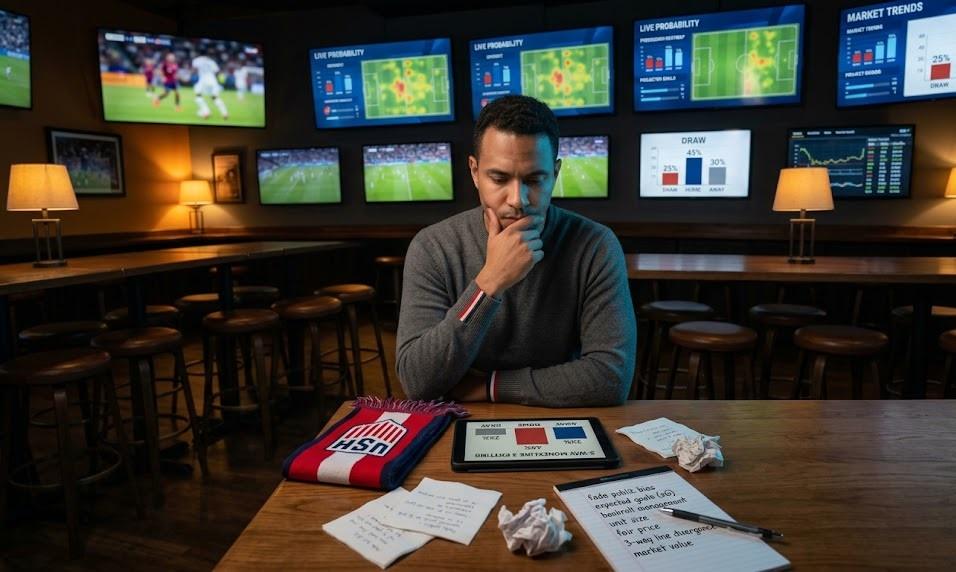
That balance matters because odds are not a patriotic press release. They are a price. If the U.S. is listed around the top of the Group D winner market, bettors still need to ask the only question that matters: is the number fair, inflated, or just emotionally convenient?
This is where Sharp-9 readers should start with the basics. A team can be the most likely group winner and still be a bad bet if the price has already baked in too much optimism. The difference between “I think the U.S. can win Group D” and “this price has value” is not small. It is the difference between analysis and buying a jersey with a betting slip attached.
For a refresher on that gap, the site’s guide to implied probability and fair value is the right starting point. Group D is exactly the kind of market where implied probability matters because public confidence can make a favorite look cleaner than the matchup tree actually is.
The USMNT Price Is Really A Psychology Test
The American price in Group D is partly about talent. That part is legitimate. The U.S. has enough athleticism, attacking variety, and tournament familiarity to deserve respect. Pulisic gives the attack a reliable reference point. McKennie brings vertical running and midfield edge. The squad is no longer the underdog novelty act from older World Cup cycles.
But the market is never just about talent. It is also about demand.
A home World Cup creates a perfect emotional cocktail: national pride, casual betting volume, social media optimism, sportsbook boosts, and a public that may treat “host nation” like a cheat code. That does not mean the U.S. is overvalued by default. It means bettors need to price the team without letting the crowd do the algebra.
Here is the basic Sharp-9 filter:
| Market Factor | What Casual Bettors May See | What Sharper Bettors Should Ask |
|---|---|---|
| Host-Nation Status | Automatic boost | How much is already priced in? |
| Group Favorite Odds | Strong confidence signal | Is the implied probability still fair? |
| Star Names | Pulisic, McKennie, Balogun hype | Does the team create reliable chances? |
| Opponent Perception | “Manageable group” | Which team is mispriced by style? |
| Public Betting Volume | Market validation | Is this value or crowd momentum? |
That last row is where markets get slippery. Public money can make a price look more stable than it really is. When a market gets attention because of flags, headlines, and broadcast build-up, the odds can start to reflect popularity as much as probability.
Türkiye Is The Kind Of Opponent That Punishes Lazy Favorites
The U.S. being favored does not mean Türkiye is harmless. In fact, Türkiye is exactly the type of opponent that makes Group D interesting from a betting strategy perspective.
Türkiye has technical players capable of changing match rhythm, especially in midfield and attacking transition. A team like that can make a favorite uncomfortable because it does not need to dominate possession for 90 minutes to distort a market. It only needs to create enough threat to make the favorite’s price look too smooth.
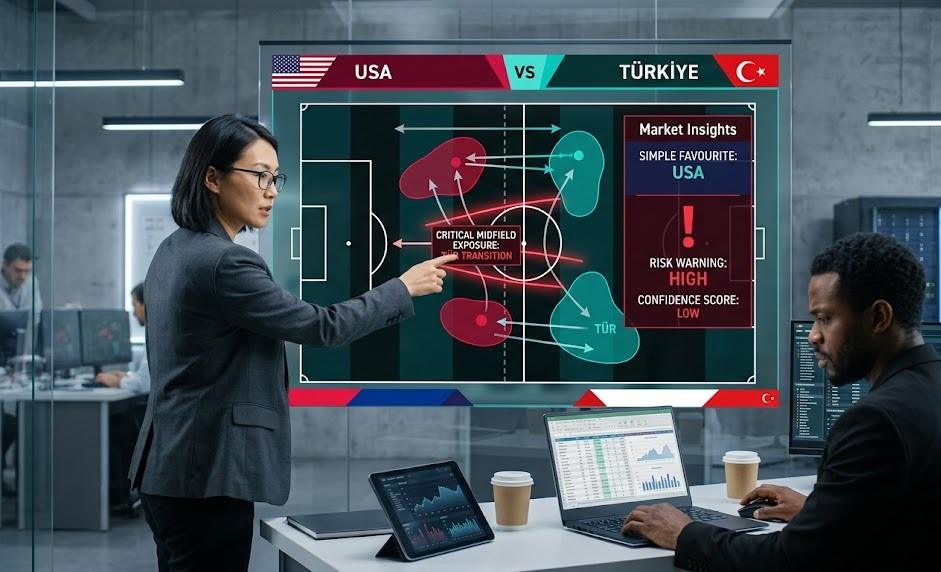
That matters in a group winner market because the price is not only about one match. It is about three matches, goal difference, rotation decisions, and the possibility that one strange result can make the entire board wobble. A bettor who sees the U.S. as the “safe” group winner may be underestimating how quickly tournament groups become spreadsheets with anxiety issues.
Paraguay and Australia complicate the same equation in different ways. Paraguay can drag a game into low-margin territory, where one goal, one set piece, or one card changes everything. Australia can turn matches into physical, low-error contests that make favorites work harder than expected. Neither needs to be glamorous to damage a short price.
Group Winner Markets Are Not The Same As Match Bets
One of the biggest mistakes bettors make is treating a group winner bet like a simple extension of team quality. That is spreadsheet vandalism.
A group winner market has multiple layers. It includes team strength, schedule order, rest, venue conditions, tactical matchups, goal difference incentives, and the emotional market response after each result. A team can win its first match and still become overvalued before match two. A team can draw its opener and become too cheap if the underlying performance was stronger than the scoreboard.
That is why Group D is useful for bettor education. It forces the market to answer questions that a simple match bet does not.
Does the U.S. need to beat Paraguay cleanly to justify the favorite price? What happens if Türkiye wins its opener more convincingly than expected? How much does the market adjust if Australia plays spoiler? Does public money rush back to the U.S. after one flashy Pulisic goal, even if the underlying chance creation was ordinary?
These are not decorative questions. They are the entire game.
World Cup Volume Makes Overconfidence Easier To Hide
The 2026 World Cup will not be a normal betting event. It will be a global betting traffic jam with better branding. The expanded 48-team format, three host countries, and U.S.-based attention will create a flood of recreational action across moneylines, props, group markets, same-game parlays, live betting, and futures.
That volume matters because overconfidence can hide inside liquidity. When everyone is betting, the market feels alive. But a busy market is not automatically an efficient one, especially in niche submarkets or emotionally charged national-team spots.
As the tournament gets closer, sportsbooks will have to manage more than odds. They will manage demand spikes, mobile betting behavior, promotional pressure, and public narratives that move faster than clean analysis. That broader pressure is already part of the industry conversation around World Cup sportsbook preparation, and Group D is a perfect example of why preparation matters.
If the U.S. wins early, the public may pile in harder. If the U.S. struggles, the panic may be just as exaggerated. Either way, bettors should expect the market to become noisier, not cleaner.
The Smarter Read Is Price Discipline, Not Anti-USA Cynicism
This article is not an argument against the USMNT. That would be lazy in the opposite direction. The U.S. can absolutely win Group D. It has the player pool, the home setting, and enough attacking upside to justify serious market respect.
The sharper point is that respect is not the same thing as value.
A disciplined bettor can believe the U.S. is the most likely group winner and still pass if the price is too short. Another bettor can see Türkiye as dangerous without pretending it is some guaranteed dark horse. Another can decide Paraguay’s defensive profile makes a draw market more interesting than the group winner board. The edge is not in being contrarian for sport. The edge is in refusing to let the crowd hand you your conclusion.
That is where Group D becomes a clean test case. It asks bettors to separate three different things that often get mashed together during major tournaments: team quality, market price, and emotional momentum.
How Bettors Should Track Group D Without Chasing The Noise
The best approach is to track Group D like a market, not like a fan argument. Start with the pre-tournament price, then watch how the odds move after each confirmed lineup, tactical adjustment, injury report, and match result. Do not treat every movement as meaningful. Some line movement is information. Some of it is just the public stepping on the scale.
The key is to compare price movement to actual performance indicators. Did the U.S. create high-quality chances or just control harmless possession? Did Türkiye’s attack generate repeatable danger or one highlight-reel moment? Did Paraguay suppress chances in a way that travels into the next matchup? Did Australia’s defensive shape force a favorite into bad shot selection?
That is the difference between reacting and reading.
If the U.S. price shortens after a win that was more comfortable on the scoreboard than in the data, overconfidence may be building. If the price drifts after a draw where the underlying performance was strong, the market may be offering a better entry point. If Türkiye or Paraguay gets dismissed because the public is focused on the host nation, the board may be telling a more interesting story than the headlines.
Group D Is A Market Literacy Exam In A Red, White, And Blue Jacket
The USMNT’s Group D odds are useful because they force bettors to confront their own assumptions. Do you like the U.S. because the price is fair, or because the story is easy? Are you betting the team, the shirt, the broadcast narrative, or the number? Are you reading the market, or just nodding along while the crowd gets louder?
That is the real Sharp-9 lesson. World Cup betting will create thousands of opinions, but only some of them will be priced correctly. Group D gives bettors a compact test case with real teams, real public pressure, and enough tactical uncertainty to punish anyone who treats market confidence as mathematical proof.
The U.S. may win the group. The U.S. may even make the price look smart. But the bettor’s job is not to cheer for the cleanest storyline. The bettor’s job is to decide whether the market has turned that storyline into a tax.