

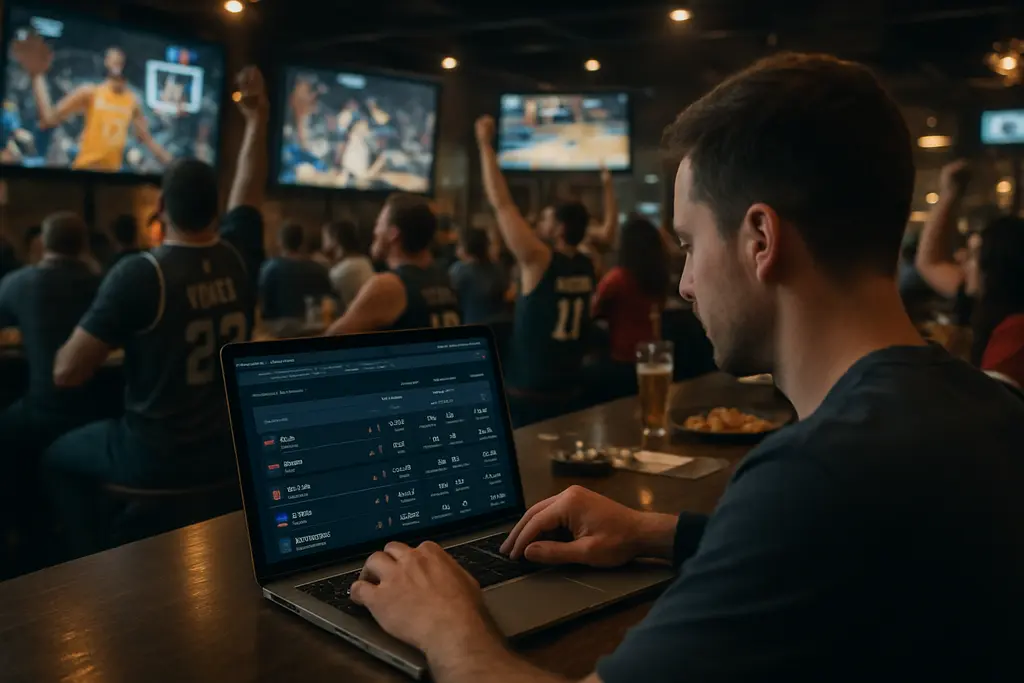
Live Betting Efficiency in NBA games is not just about how fast a number moves after a made three, a timeout, or a foul that puts a starter on the bench. For U.S. bettors comparing regulated books with offshore sportsbooks, the sharper question is whether the market is deep enough to keep prop offerings open, priced, and usable after the game starts. A live prop board can look full before tip-off and then turn into a dark hallway once possessions start piling up. That is where market depth matters.
The research base supports one clear point: live betting has taken a larger share of the sportsbook menu. Live and in-play wagering made up roughly 55% of U.S. online sportsbook handle across major sports in 2026, up from 38% in 2022 and 49% in 2024, according to a 2026 live betting guide from Tech Insider. NBA betting followed the same path. During the 2024-25 NBA season, the live share of NBA handle rose from roughly 25% in 2022 to over 40%, with player props leading that migration, as reported by Last Word On Basketball.
Live Betting Efficiency And NBA Prop Depth
Why Live Betting Efficiency Starts With Acceptance
Live Betting Efficiency begins with the offer staying alive long enough for a bettor to make a rational comparison. A prop that flashes on screen, suspends, reopens, and then changes again may be technically available, but that does not mean the market is useful. NBA possessions are short. Injury checks, substitution patterns, foul trouble, pace changes, and score pressure can all alter a player’s projection in a few seconds. The sportsbook has to decide whether to keep writing action, pull the market, or widen the price.
For a cautious bettor, the danger is not only a bad number. It is the illusion of choice. A board may show points, rebounds, assists, threes, turnovers, double-doubles, and combination props before tip-off. Once the game starts, the deeper operator can keep more of those markets open through normal play. The thinner operator may leave only star-player props or main markets. That difference is not cosmetic. It affects comparison shopping, timing, and whether a bettor can even see enough prices to judge value.
What Prop Menus Signal Before Tip-Off
Before tip-off, major U.S. sportsbooks were reported to list nearly 200 to 400 individual player props per NBA game. That does not mean every book carries the same prop mix, the same limits, or the same live availability after the opening jump. It does tell us that the modern NBA menu has become broad enough that market depth is now part of handicapping. The handicap is not only a player projection. It is also a question of which operator can support that projection in real time.
Deep menus tend to concentrate around high-usage players because those markets attract more volume and can be priced with more confidence. Bench players, low-minute wings, and role players with volatile usage often live in thinner territory. That can mean fewer alternate lines, fewer live reopenings, and less useful comparison across books. The board may be bright for the stars and murky for everyone else. That is not a conspiracy. It is the shape of liquidity.
Market Depth Across Regulated And Offshore Books
Star Props, Bench Props, And The Thin Board
For U.S. bettors comparing regulated and offshore books, the same NBA game can look like two different creatures. One book may carry a wide pregame prop menu but tighten quickly after tip-off. Another may keep live points and rebounds active for star players while leaving assists or combo props suspended for long stretches. A third may show a smaller menu but accept more steadily. Without current, sourced operator odds, there is no honest way to rank those books in this article. The sounder approach is to compare structure rather than pretend a fixed edge exists.
The first structural question is breadth. How many NBA prop types appear before tip-off, and how many remain after the first few minutes? The second is continuity. Do props suspend after every rebound, foul, or substitution, or do they reopen quickly? The third is pricing discipline. Are spreads between over and under prices reasonable compared with main markets, or does the prop board carry enough extra margin to make comparison shopping harder?
Offshore books sometimes attract attention because their menus can differ from regulated U.S. operators. That difference can be useful for market comparison, but it also raises questions about jurisdiction, withdrawal rules, account terms, and dispute options. Bettors should read house rules before funding any account and avoid assuming that a larger board is automatically a better board. For a deeper dive into related sportsbook topics, Amazing Sportsbooks offers insights as part of the same network.
Comparing Live Betting Efficiency Without Chasing Ghosts
Comparing Live Betting Efficiency requires a notebook mindset. The scary part of a live NBA board is that it can make a bettor feel late before any decision is made. A missed free throw changes a player’s points path. Two quick fouls can kill a minutes projection. A blowout can turn the fourth quarter into garbage time and pull stars from the floor. The bettor staring at five tabs is not only comparing numbers. He is racing the clock, and the clock has teeth.
A practical review does not need invented odds. It can track what happened. Did the book offer the same player’s points prop in the second quarter? Did it keep rebounds open during free throws? Did the offshore option show a line but reject the bet after a long pause? Did the regulated book carry fewer props but settle into a clearer rhythm? These observations help separate a deep live market from a painted window.
Readers who want a related framework can compare this discussion with prop depth across offshore and regulated books, especially where hold, limits, and recourse shape the real cost of a broader menu. The key is to judge the entire transaction, not just the first number shown on the screen.
- Availability: Which props remain open after tip-off, halftime, and late-game rotations?
- Acceptance: Does the book accept the wager, re-quote it, or suspend the market?
- Depth: Are role-player props available, or only stars and main markets?
- Price Quality: Does the margin appear wider on props than on spreads and totals?
- Account Risk: Do terms, limits, and jurisdiction fit the bettor’s tolerance?
Live NBA Prop Markets For U.S. Bettors

Live NBA prop markets reward patience more than bravado. The bettor who treats every suspension as an insult will end up chasing shadows. The bettor who logs availability, timing, and price changes across books can learn which operators provide depth and which simply display a long menu before the game starts. That difference matters more as live handle grows and player props take a larger share of NBA betting activity.
Live Betting Efficiency is best viewed as a market-quality test. A sportsbook can be fast but shallow. It can be deep before tip-off but thin after the first timeout. It can carry dozens of props while attaching enough margin to make the comparison less attractive. Regulated books and offshore sportsbooks should be judged on the same practical questions: what is offered, how long it stays open, whether bets are accepted cleanly, and what protections exist if something goes wrong.
No bettor should read a prop menu as a promise. Lines move, markets suspend, and operator rules vary. The safer habit is to compare before the game, observe during the game, and record what actually happens. In NBA live betting, the monster under the bed is not always a bad projection. Sometimes it is a market with no depth behind the face it shows you.